

Late-stage check · Noise
GPU servers don't hum like your old servers.
Ask how loud before you buy.
Your switches, storage and UPS are background hum. An air-cooled server with eight GPUs moves its heat with fans alone, and that is what you hear.

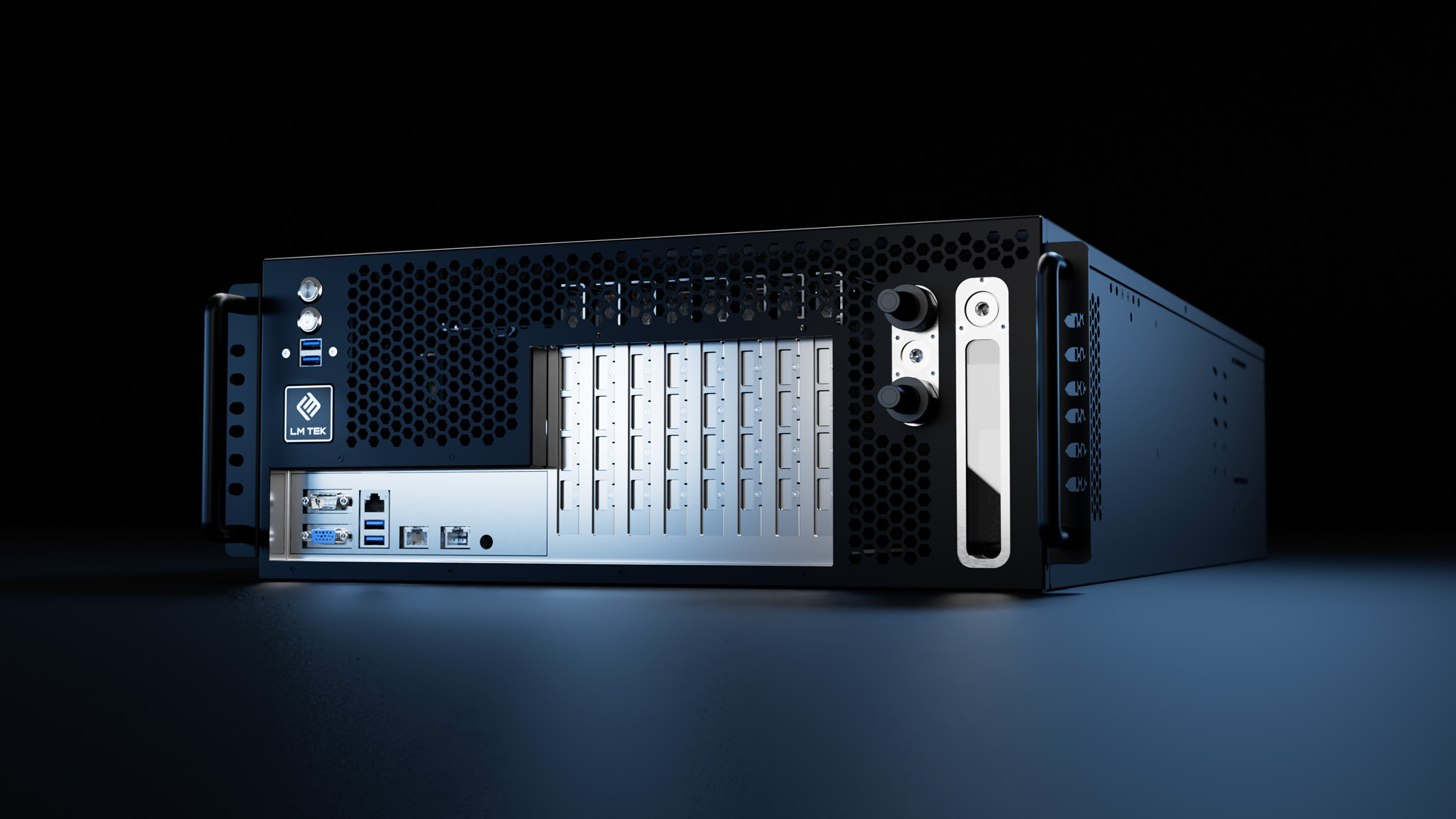
- LM TEK 4U8GPU10KW
- 8 × full-height PCIe Gen 5
- 4U · 19-inch rack
- 5 × 2 kW with redundancy
- 5 – 30 °C ambient · 5 – 60 °C coolant
- No facility plumbing · no external CDU
Noise math
An air-cooled 8-GPU server can reach 106 dB.
The fans make the noise. Imperfect cooling puts all of the work on them.
To move up to 7 kW of heat with air alone, an air-cooled 8-GPU server spins its fans hard. A leading air-cooled system is published at up to 106 dB: between a motorcycle and a chainsaw.
On the decibel scale
Indicative only: sources measure differently. Reference sounds: Commercial Acoustics decibel level chart.
-
A different class of sound.
An 8-GPU server is not background hum. Plan for it before the order, not after delivery.
-
Plan where it lives.
Distance and walls decide who hears it. A room next to offices is a different plan from a basement.
-
Efficiency counts.
The less work the fans have to do, the less you hear.
Who we are
We specialise in liquid cooling.
So that servers and workstations can operate at their full capacity in normal business environments, without sounding like a server hall.
Illustrative visualisation. Flow paths and temperatures are a simplified model, not CFD or measurement.
Why air cooling is loud
Air takes the easy way around.
The fans push far more air than the GPUs need, because most of it never touches the fins.
01 · The path of least resistance
A row of trees shelters a house.
Air can pass through leaves, but trees are a dense obstacle, so most of the wind goes over them. Airflow has always worked this way.
02 · Air cooling, from above
Every heatsink is a windbreak.
A passive GPU cooler is a dense block of fins. Most of the air slips through the gaps beside the cards, so the fans have to push far more air to force enough through the fins. That is the noise.
Illustrative animation after the LM TEK cooling explainer. Flow paths are simplified, not CFD or measurement.
We're here to help
Not sure yet? Let's talk.
GPU servers bring many new, complicated decisions, and they cost too much to be sloppy with.
Tell us what you're planning. We'll arrange a short call to help you understand the decision, or recommend an integrator partner. Our partners install servers every day.