
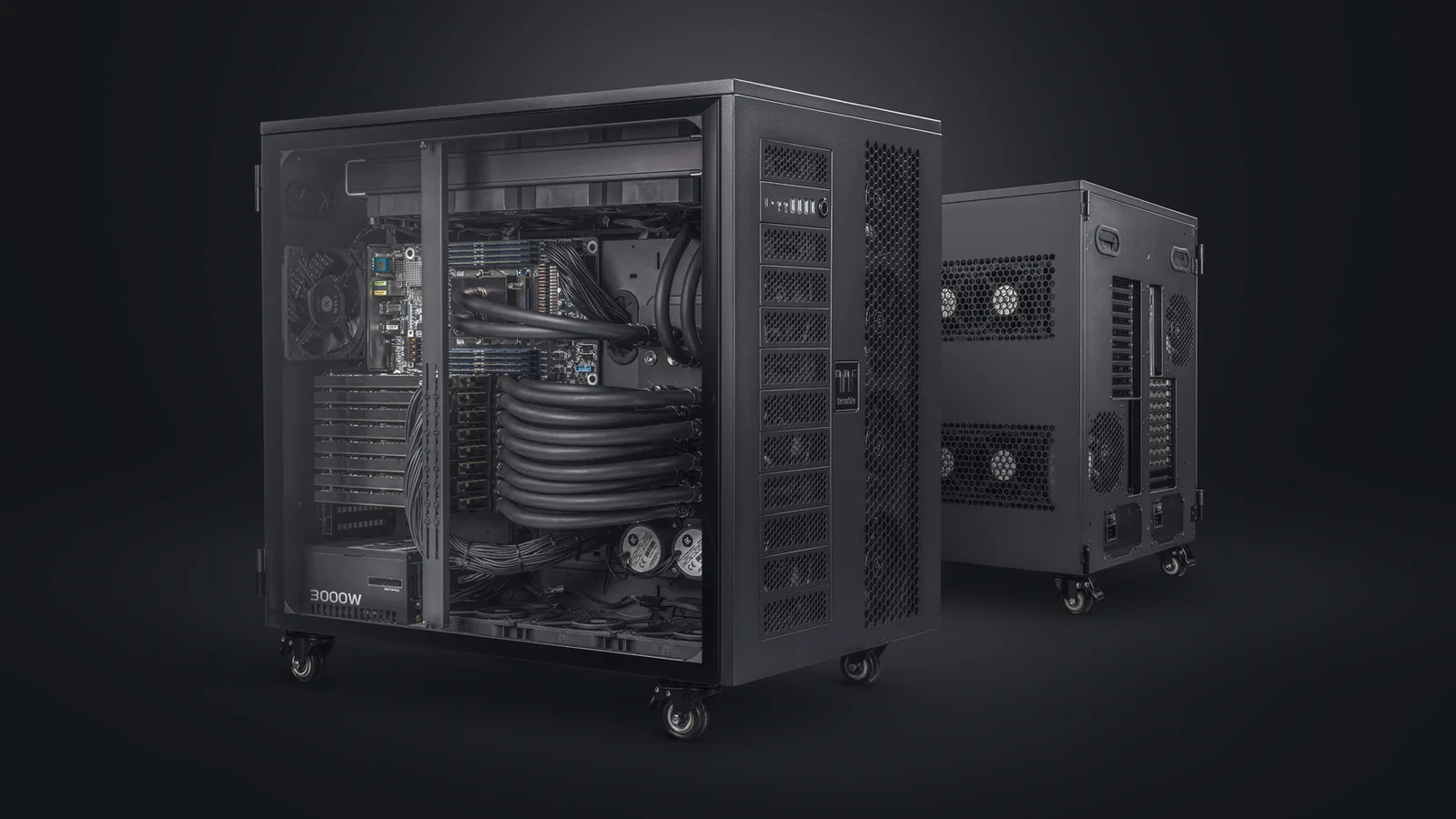
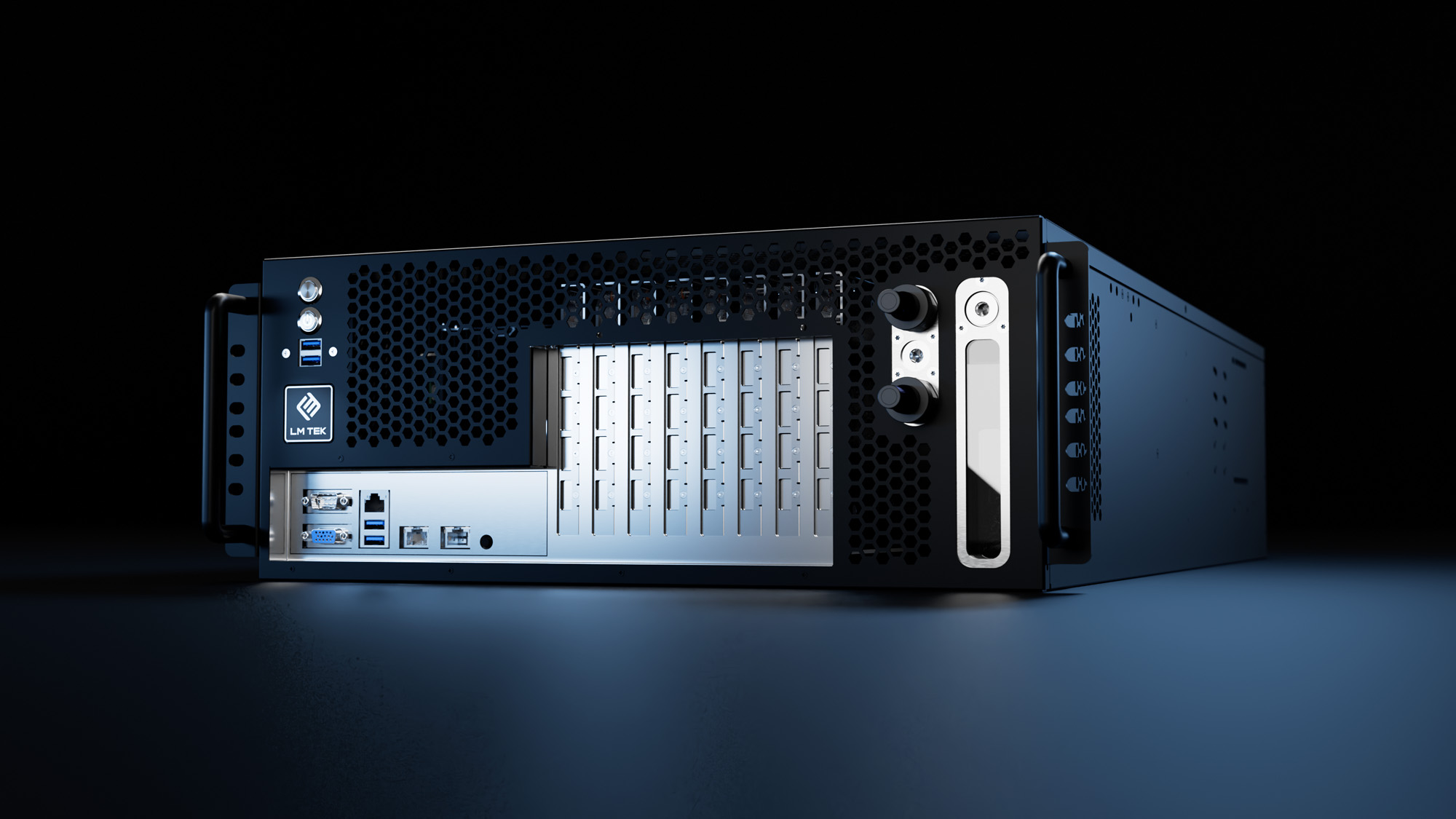
Eight GPUs in 4U, liquid-cooled, in a standard server room.
Renting the cloud means the data and the models leave the building. Building a liquid-cooled datacentre means a construction project. The third option is datacentre-class GPU density in the server room your organisation already has.
A barebone platform: LM TEK supplies the chassis, the integrated cooling loop, and platform-level power. You specify the board, CPUs, GPUs, memory, and storage.
- GPU slots in 4U
- 8 × 700 W
- Sustained chassis power
- 8000 W
- Operational water use
- Zero
Between renting the cloud and building a datacentre.
Most organisations running AI face two unappealing options. Rent GPUs in the public cloud, and the data and the models leave the building. Build a liquid-cooled datacentre, and a routine hardware purchase becomes a construction project. In between sits the reality most companies actually live in: a normal server room, never designed for 20 kW racks.
The LM TEK 4U8GPU10KW is built for that room. It closes the entire liquid cooling loop inside the chassis, with the radiator on the front intake, so datacentre-class GPU density arrives without facility plumbing and without an external Coolant Distribution Unit (CDU). Eight full-height GPU slots fit in four rack units, where an air-cooled server of the same GPU count needs six or eight.
The platform deploys at single-server or small-cluster scale: one unit in an existing rack, or several as a compact GPU pool, without facility changes.
This is what makes Sovereign Enterprise AI physical: compute in the building you already have, and data and models that never leave it.
Sovereign Enterprise AI →Engineered as one thermal and power system.
- 01
One loop, engineered in
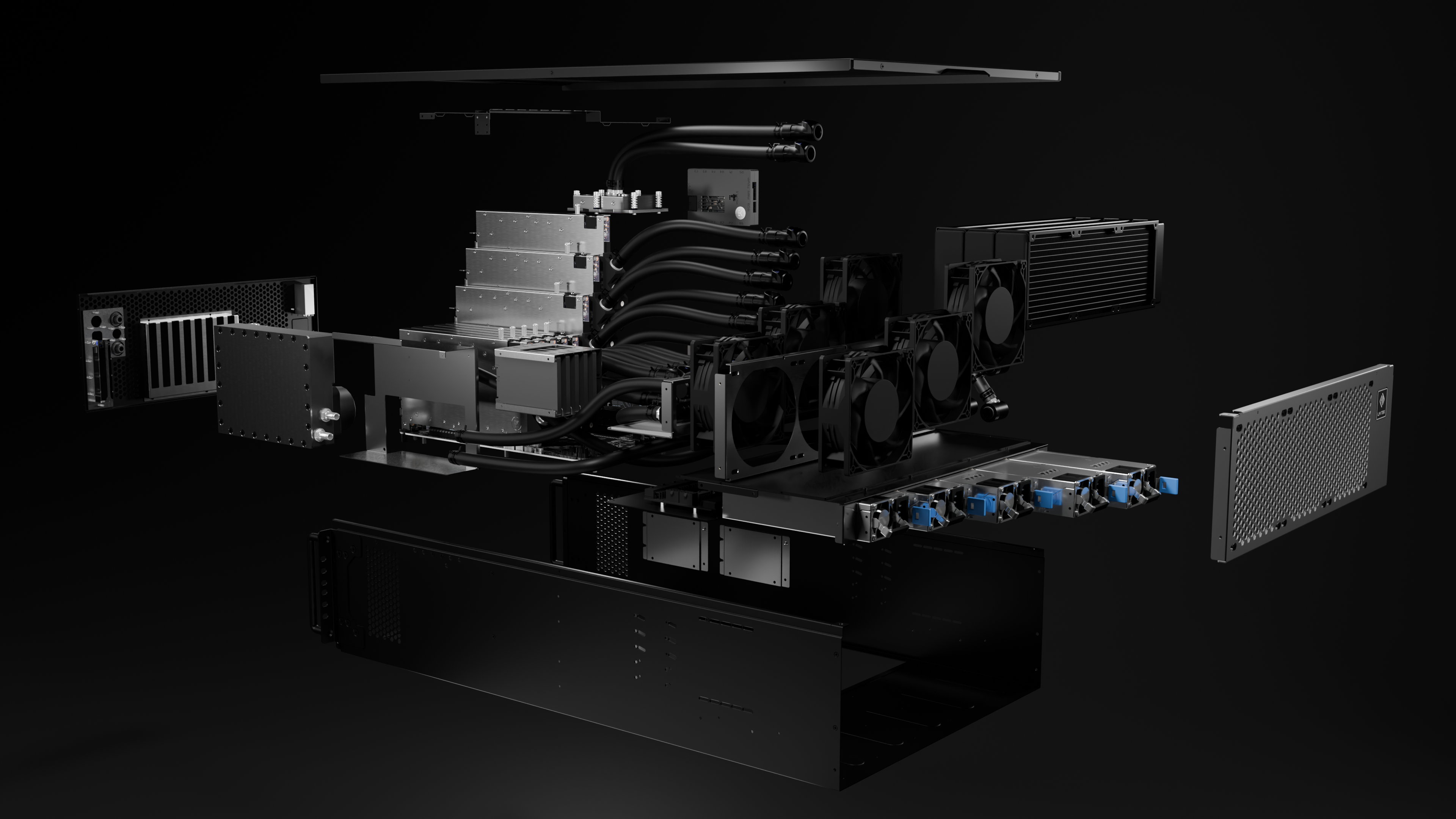
The chassis is built around the closed cooling loop, and the PCIe slot layout follows the loop’s physical envelope rather than a board form factor. Pump, manifold, GPU and CPU water blocks, radiator, and reservoir all live inside the chassis, with the radiator on the front intake so airflow paths are engineered alongside the loop.
- 02
Density by design
Liquid cooling collapses each GPU’s thermal solution into a single-slot water block. That, not a bigger box, is how eight full-height PCIe Gen 5 cards, up to 700 W per slot sustained, fit in a 4U envelope where air-cooled equivalents need 6U or 8U.
- 03
Power sized at the chassis
Five 2000 W 80 PLUS Titanium PSUs with redundancy and a platform-level PDU size the GPU power budget at the chassis, independent of the motherboard VRM, with headroom for the full eight-GPU configuration at up to 8000 W sustained.
- Ownership and the four freedoms → Validation evidence →
The platform you specify.
The chassis, the integrated cooling loop, and platform-level power arrive engineered as one system; the board, CPUs, GPUs, memory, and storage are specified per deployment. One chassis carries a configuration from a two-GPU entry build to eight accelerators at up to 700 W per slot.
LM TEK AI & HPC Server Platforms
LM TEK 4U8GPU10KW
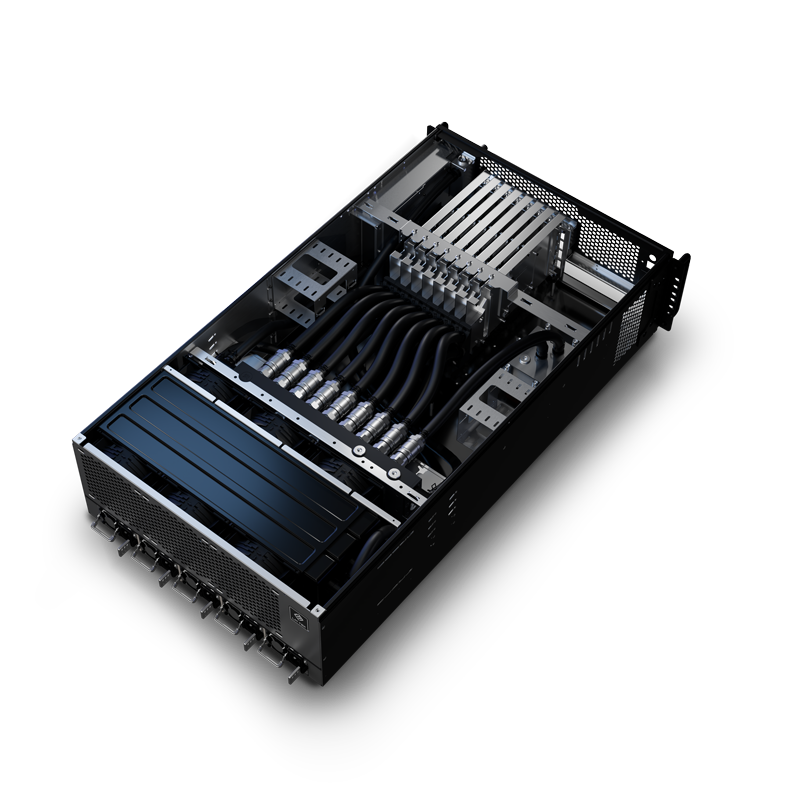
A barebone AI server platform: eight full-height PCIe Gen 5 GPU slots in a 4U chassis, engineered around a closed liquid cooling loop with an in-chassis radiator, so it deploys in a standard server room without facility plumbing or an external CDU. Platform-level power, no motherboard lock-in. Cooling designed by the EK engineering team; engineered and assembled in Komenda, Slovenia.
- GPU density
- 8 slots in 4U
- Sustained power
- Up to 8000 W
- Deployment
- No CDU, no plumbing
| Tier | Reference configuration | Use case |
|---|---|---|
| Modest start | 2× RTX 6000 Ada · 1× EPYC 9354 · 256 GB DDR5 ECC | Departmental AI / single-team inference |
| Mid-tier | 4× RTX PRO 6000 Blackwell · 2× EPYC 9474F · 512 GB DDR5 ECC | Research group / multi-user inference / light fine-tuning |
| Production maximum | 8× NVIDIA H200 NVL · 2× Xeon Platinum 8580 · 1 TB DDR5 ECC | Enterprise inference / production fine-tuning |
Reference configurations are examples drawn from real customer builds, not a fixed bill of materials. The final BOM is specified per deployment; a configuration inside the published validation specs is quotable as is, and LM TEK engineering is available for anything outside them.
Sizing a first deployment?
The buying guide covers how to start small without throwing early spend away.
Cooling designed by the EK engineering team.
The loop uses the materials discipline, pressure envelope, and manifold geometry of the EK liquid-cooling reference, transferred to enterprise rack scale by the EK engineering team, twenty-five years in high-performance liquid cooling. The materials stack is the same as the LM TEK liquid-cooling catalogue: nickel-plated copper, stainless steel, POM Acetal, EPDM. Engineered and assembled in Komenda, Slovenia.
Why the middle tier of compute exists
The category argument for dense, in-sourced compute between the hyperscale datacentre and the public cloud lives one level up, and it covers workstations as well as servers.
Read the Engineering Case →Specifying, or building for customers.
Specifying a deployment?
The platform ships with published validation specs: supported board formats and sockets, the per-slot GPU envelope, block availability, and the operating limits. A configuration inside them is quotable as is. For a board, GPU, or cooling requirement outside them, send LM TEK engineering the intended configuration.
Building solutions on the platform?
The barebone model is deliberate: LM TEK supplies the platform and the engineering, and the silicon specification, integration, and services stay the system integrator’s business. If you deliver AI infrastructure to your own customers, the partner conversation starts here.